CLP Revenue — Scenario Overview

Solver-side economics (CLP vault only). Does NOT include front-end trading fee or Carbon treasury revenue — those are modeled separately in the holistic fee view. Click any card to load it in the Simulator tab for tweaking.

Shared assumptions across all scenarios: $1M vault · 30/50/20 split · 5 bps spread · 4% overnight markup · 70% overnight OI share · 0.5% liq capture · 0.5 bps VV commission. Hard costs only — infra, tail reserve, insurance all at 0 (analyzed separately).

Roadmap (3 stages): Launch / Growth / Base differ on OI cap (3× → 5× → 8×) and turnover (0.85 → 0.80 → 0.75). Sensitivities at Base: Bull and Bear differ from Base only on util and turnover (pure demand-axis variants).

LP APY comparison

Narrative per scenario

CLP Revenue Simulation

Live model — solver vault side only. Pull sliders or type values. Click i next to any knob for definition + formula + typical values.
âš  Allocation:
⚠ Utilization: Above 80% trips circuit breaker CB-5 per operating rules §5. Halt new positions.
⚠ Below break-even: Net revenue negative — fixed costs exceed gross revenue. Expected at small vault sizes. See §5B of revenue model doc.
âš  Inconsistent: High liquidation capture (>2%) + high tail reserve (>2%) is internally contradictory. They describe the SAME gap distribution from opposite sides.
LP APY (post-insurance)
13.2%
$132K/yr to LPs
Net APY (vault)
15.9%
$159K/yr after costs
Gross APY
22.5%
$225K/yr
Max OI
$8.0M
8.0× vault

Revenue streams annualized, at current knobs

Avg OI: $3.2M  Â·  Daily volume: $970K  Â·  Annual volume: $244M
Spread markup
$122K54%
Overnight premium
$91K40%
Liquidation capture
$12K5%

Costs annualized, actual cash drag

Real cash outflows + accounting reserves only. Idle buffer is NOT a cost — it's just not producing revenue (enable buffer yield knob for v2).
Rebalancing (gas + bridge)
$8K
Infrastructure
$18K
VV commission
$12K
Tail loss reserve
$40K

Vault scaling current knobs, varied vault size

How APY changes with vault size. Below ~$500K, fixed costs dominate.
Vault Max OI Gross APY LP APY

Sensitivity ±10% on each knob

How LP APY shifts if you change ONE knob. Biggest-impact at top.
Knob −10% Current +10%

P&L waterfall gross → LP distribution

Revenue streams in, costs and reserves out, LP distribution at the end. Bar width shows magnitude.
Empirical Validation — 90-Day Perp DEX Benchmark

Carbon's turnover defaults benchmarked against 6 comparable on-chain perp DEXes. Source: DeFiLlama AI Terminal, run 2026-04-25. Window: 90 days through Apr 25, daily granularity.

Headline Finding

Carbon's turnover assumption isn't a guess. The simulator's Base default of 0.75 matches Ostium's 90-day median (0.755) — the closest RWA-native comparable — and sits just below Variational's 1.03 (RFQ-based RWA perp). The cross-peer median of 1.39 is pulled up by reward-incentivized CLOBs (Lighter 2.75, dYdX v4 2.55) that don't represent organic RWA flow.

No simulator default needs material adjustment. The model is well-calibrated.

Methodology

Six protocols selected to span the relevant comparison axes for Carbon (CFD-style perp DEX, RWA focus, RFQ + bilateral hedging architecture):

  • Hyperliquid, Lighter, dYdX v4 — high-volume crypto perp DEXes (active-trader benchmark)
  • Variational — RFQ + OLP architecture (RFQ-based RWA comparable)
  • Ostium — RWA-native, trades commodities/FX (Carbon's market-fit twin)
  • GMX v2 — LP-pool reference (vault-economics comparable)

Three primary metrics requested: Open Interest (daily series), Daily Volume (series), Turnover Ratio (volume/OI computed daily). Liquidations attempted as stretch — DeFiLlama doesn't expose perp liquidation history, so that metric is unavailable from this dataset.

Data quality guardrails applied: known incentive programs flagged (HL, Lighter, dYdX v4, GMX v2 had active rewards during the window); only total volume available (not organic) — treat all turnover ratios as upper bounds on organic flow.

Open Interest — 90-Day Daily Series

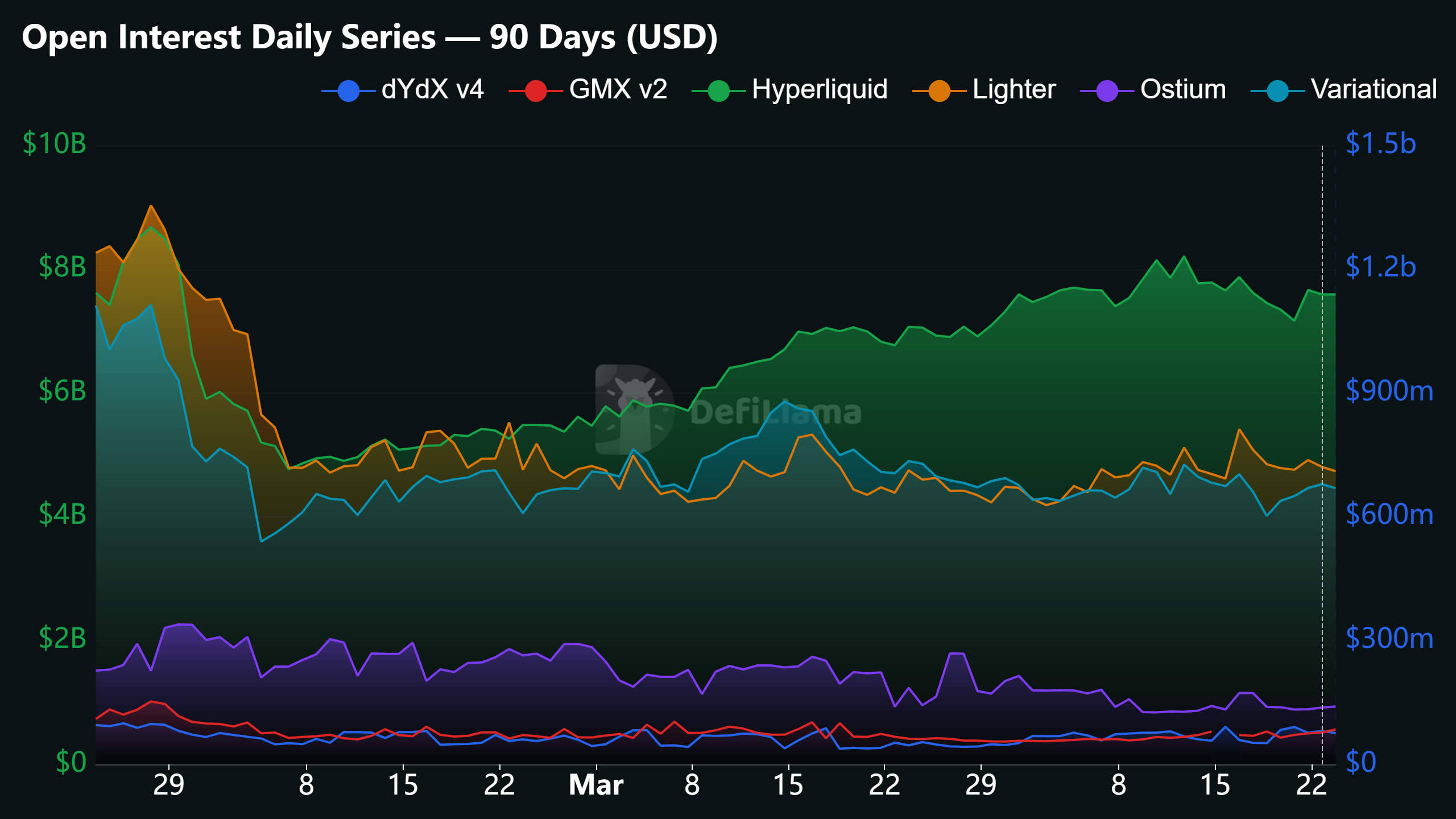
Open Interest daily series for 6 perp DEXes

Hyperliquid dominates absolute OI ($6.83B 90-day median, left axis). Lighter and Variational cluster around $700M (right axis). Ostium runs at ~$225M but declining through the window. dYdX v4 and GMX v2 sit near the floor.

Protocol90d median OICurrentTrend
Hyperliquid$6.83B$7.66BUp — bullish growth
Lighter$718M$708MStable, one mid-window spike to $1.36B
Variational$691M$658MStable, modest range $540M-$1.11B
Ostium$225M$140MDeclining from $339M peak
GMX v2$71M$87MStable at floor
dYdX v4$67M$74MPersistent decline

Turnover Ratio — The Headline Number

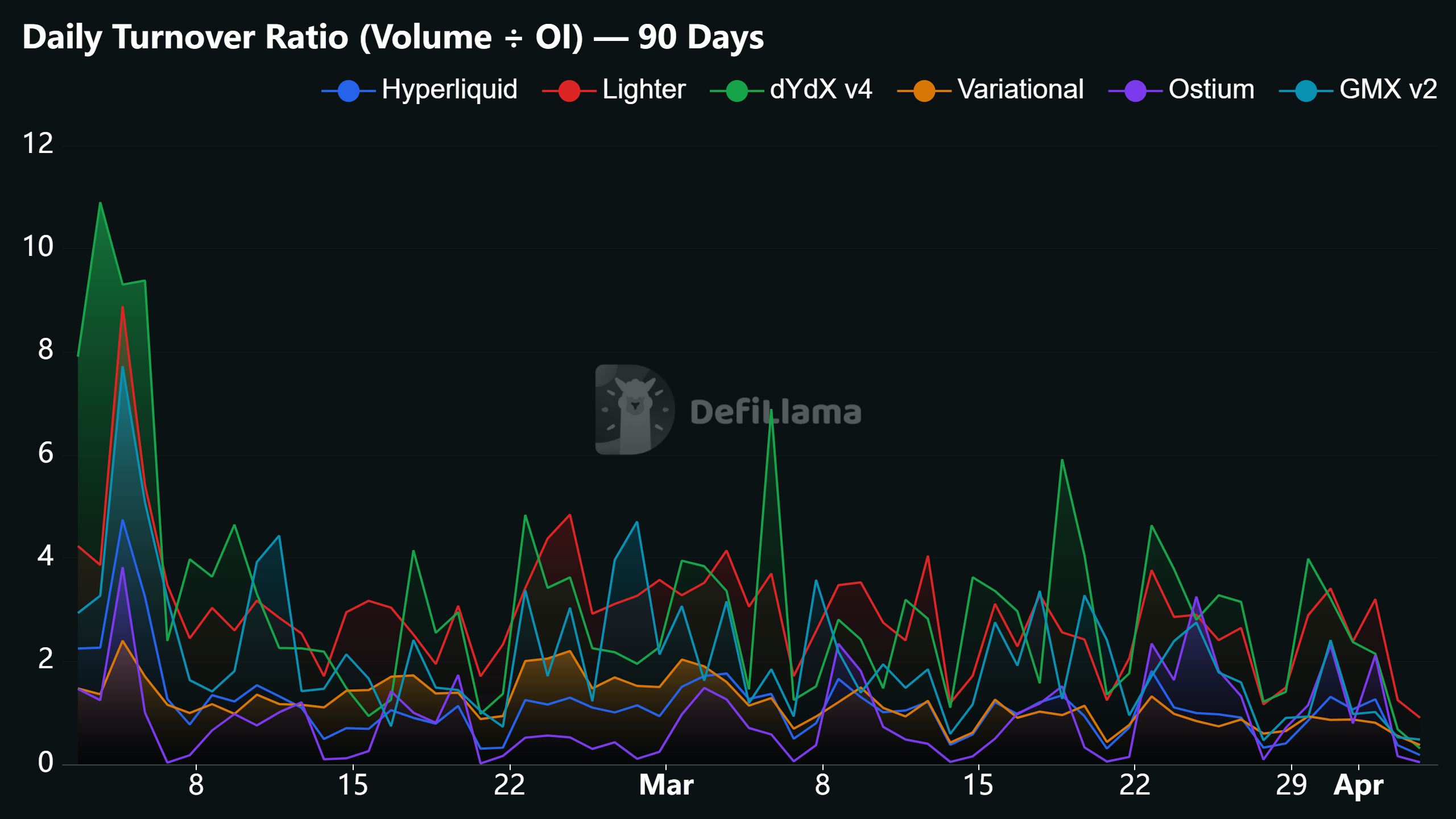
Daily turnover ratio for 6 perp DEXes

Daily volume divided by daily OI. The single most-important calibration number for the simulator.

Protocol90d median turnoverArchitectural fit to Carbon
Lighter2.75CLOB + incentives — wrong reference for RWA
dYdX v42.55CLOB + DYDX rewards — wrong reference for RWA
GMX v21.75LP-AMM + ARB incentives — partial reference
Cross-peer median1.39Pulled up by reward-incentivized CLOBs — not the right anchor for an RWA product
Variational1.03RFQ + RWA → anchors Carbon Bull (1.0)
Hyperliquid1.02Largest absolute OI ($6.8B) — whale-volume scale, not launch comparable
Ostium0.755RWA-native — market-fit twin → anchors Carbon Base (0.75)

Calibration to Carbon's Defaults

The right reference for Carbon is the RWA-native cluster: Variational + Ostium midpoint = 0.89. Carbon's stage-decay defaults sit in or just below this band:

Carbon stageDefault turnovervs RWA midpoint (0.89)Verdict
Launch0.85-4.5%✓ Essentially matching
Growth0.80-10%✓ Within band
Base0.75-16%✓ Deliberately conservative; matches Ostium 90d median exactly
Bull1.00+12%✓ Sits between Variational (1.03) and Hyperliquid (1.02)
Bear0.50-44%✓ Above Ostium 90d MIN (0.019); plausible "demand softens" floor

Why we're conservative on Base. Pre-launch product — the model should under-promise. Once we have 90 days of our own data we'll calibrate up if observed turnover supports it.

Why we ignore the cross-peer median (1.39). It's contaminated by Lighter and dYdX v4 — both CLOB venues with reward-incentivized scalper cohorts that don't represent organic RWA flow. Anchoring to the wrong reference would inflate our model.

Caveats and limitations

  • No organic-volume distinction. DeFiLlama does not separate organic from total volume for perp derivatives. All volume figures (and therefore all turnover ratios) are upper bounds on organic flow.
  • Reward-program contamination in 4 of 6 protocols. dYdX v4 (DYDX trading rewards), GMX v2 (ARB incentives), Lighter (points program suspected). Hyperliquid 2026 reward status not confirmed by DeFiLlama. This pushes turnover ratios up — read all numbers as ceiling rather than floor.
  • Variational and Ostium are relatively young. Their turnover may not yet reflect mature-market behavior. Best-available anchors but numbers may evolve.
  • Liquidations data gap. DeFiLlama doesn't expose perp liquidation history. Our 3.5%/mo liquidation-rate assumption remains uncalibrated. Direct on-chain log queries per protocol is the next step (queued).
  • 90 days is a short window. Single-event volatility (e.g., the Feb 5 spike on Hyperliquid where one day showed 4.75× turnover) can move medians materially. Quarterly refresh is the mitigation.

Citation

Carbon Labs, "90-Day Perp DEX Benchmark," 2026-04-25. Source: DeFiLlama AI Terminal. Comparable protocols: Hyperliquid, Lighter, dYdX v4, Variational, Ostium, GMX v2. Window: 90 days through 2026-04-25, daily granularity.

Refresh cadence: Quarterly, or sooner if a new comparable launches (e.g., another RWA-native perp DEX) or major reward programs at Lighter/dYdX/HL end.

CLP Revenue Model — Documentation

Parameter definitions, formulas, conventions, and assumptions for the solver vault side only. Front-end trading fees and Carbon treasury revenue are modeled in a separate (future) holistic fee view. This is the reference manual for everything in the Simulator tab.

Conventions

Spread markup is per round trip, not per leg

When we say "5 bps spread markup," that is the full round-trip spread — a user opening and closing a $10K position pays $5 total in spread revenue. It is NOT doubled to 10 bps by counting open and close separately.

In the formula, daily_volume = avg_OI × turnover represents one leg (closes = opens in a balanced book). Applying the markup bps to this quantity captures the spread once per position cycle, matching CFD broker convention.

Turnover is "fraction of book that closes per day"

Turnover = 0.75/day means 75% of the book turns over each day — i.e., the average position duration is 1 / 0.75 ≈ 1.33 days. This is day-trader/scalp-heavy; retail CFD is typically 0.15–0.3.

Hard operational costs only

Default setup (Tail = 0, Infra = 0, Insurance = 0) captures only cash outflows that hit the vault: rebalancing, VitaVerse commission. Soft costs (infra dollar drag, tail reserve, insurance) are analyzed separately per §4 of solver-revenue-model.md. Toggle the sliders above 0 to model them.

Market-neutral, all positions hedged 1:1

The solver opens an on-chain position against the user, then opens an equal and opposite position off-chain on VitaVerse. Net directional exposure = 0. Revenue comes from spread + overnight rate premium + liquidation CVA capture, not from price movement.

Price post-hedge (why no slippage cost)

The solver sources the hedge fill from VitaVerse first, then quotes the user a price based on that fill. Any slippage on the VitaVerse leg is automatically baked into the user's price — the solver captures it as part of the spread. This is why hedge slippage is NOT a separate cost line.

Core Equations

Max Open Interest

Max_OI = Vault × OI_cap

OI cap is the product-level declaration (e.g., 8× vault = we're willing to run up to $8M of notional OI against a $1M vault). The implied solver leverage on off-chain margin is derived:

implied_solver_lev = OI_cap / off_chain_pct

Example: OI cap 8× at 50% off-chain → 16× implied solver leverage. Must stay below VitaVerse broker ceiling (~20× for stocks).

Revenue streams

Spread revenue = Annual_volume × spread_bps × 10â»â´ Overnight rev = Avg_OI × overnight_OI_ratio × overnight_markup Liquidation rev = Avg_OI × liq_rate × 12 × liq_capture Buffer yield = Buffer_dollars × buffer_yield_pct (v2 upside, default 0) Gross = sum of the above

Where:

Avg_OI = Max_OI × utilization Daily_volume = Avg_OI × turnover (one leg — closes or opens, balanced) Annual_volume = Daily_volume × 252

Costs (hard operational cash)

Rebalancing = rebal_k × 1000 (fixed $/yr) Infrastructure = infra_k × 1000 (fixed $/yr, 0 by default) VV commission = Annual_volume × commission_bps × 10â»â´ Tail reserve = Avg_OI × tail_pct (accounting reserve) Total costs = sum of the above

Net and LP distribution

Net revenue = Gross − Total costs Insurance reserve = max(0, Net) × insurance_pct LP distribution = Net − Insurance LP APY = LP distribution / Vault

Liquidation capture nuance

Not every liquidation generates CVA capture. Only gap-event liquidations (price moves past margin while market is closed/halted) return CVA to the solver. Intraday margin breaches return user collateral to the user; solver captures ~0.

Blended C = P(gap|liq) × E[CVA − gap | gap event]

Rough sizing: P(gap|liq) ≈ 30%, gap-event capture ≈ 1.5% → blended C ≈ 0.5%. Tail events (P99.9) can drive C negative for a month.

Parameters — Full Reference

Same content as the info-icon tooltips on the Simulator tab, laid out in one place.

Preset Scenarios

Key Assumptions & Caveats

  • Volume counts one leg, not both. Daily volume = closes (= opens in balanced book). Applying spread markup once matches the CFD industry "round-trip spread" convention.
  • Overnight markup is annualized. The blended 4% already accounts for the mix of 252 trading days (stocks) and 365 days (FX carry). Don't re-annualize.
  • Liquidation capture assumes P(gap|liq) ≈ 30%. This is an estimate — calibrate with 30 days of operating data. If most liquidations are intraday, capture drops toward 0.
  • Commission is a placeholder pending VitaVerse fee schedule confirmation (§13 open items in operating rules).
  • Tail reserve and insurance default to 0 — they're soft costs analyzed separately. Toggle sliders up to model them.
  • Demand side is independent of vault size. Util + turnover describe the absolute book activity. Shrinking vault concentrates the same absolute demand into higher effective utilization — see "Bear deallocation" strategy.
  • Front-end trading fee is separate. Carbon charges an additional 1–2 bps at the front end (goes to treasury, not CLP). Users see total cost = solver spread + FE fee.

Methodology & sources

  • Solver revenue model — full mathematical derivation including spread revenue, overnight rate revenue, liquidation capture, and cost stack. Available on request.
  • Solver operating rules — capital allocation (30/50/20 split), circuit breakers, per-symbol parameter table. Available on request.
  • RWA risk analysis — gap-risk distribution, volatility regimes, leverage calibration per asset class. Available on request.
  • Empirical validation — turnover ratio benchmarked against 6 comparable on-chain perp DEXes (Hyperliquid, Lighter, dYdX v4, Variational, Ostium, GMX v2) over 90 days. See the Validation tab above for the full analysis, charts, and calibration vs Carbon defaults.